Tuesday, April 22, 2014

Happy Earth Day!

I'm excited to announce I've been admitted to the Masters of Geology program at Southern Methodist University!  I plan to research the resiliency of ecosystems and how past disturbances impact biodiversity, and hope to focus on events from the past ten thousand years.  I'm mulling over ideas for a thesis project, so any suggestions are welcome.   I'll be learning a lot about Earth over the next two years!

Kitty cat from the good ol' days

A really fun exploration event has live camera coverage from the ROV aboard the Okeanos Explorer.  A few days ago, they were exploring shipwrecks 4,000 feet deep.  So deep, they haven't seen light in 200 years, so it was a thrill seeing the live feed from the ROV's camera.  They discovered the ship's sextant and a clock frozen in time, and an engineer for the ROV speculated on the implications.

Life on an eternally dark shipwreck


Also to celebrate Earth Day, Kepler has found a cousin for earth, now called Kepler-186f.  The planet is about the same size as Earth, but the star is smaller and dimmer.

Exciting real-estate opportunities abound!

Tuesday, March 4, 2014

On Seeing More

A few days ago, the Kepler team announced the confirmation of 715 new planets from other solar systems, which is the largest number of planet discoveries ever announced and almost doubled the total in the Exosolar Planetary Catalogue.  This refinement served greatly to understand some census statistics for stars; how common are planets, are they usually in a group, and how massive are they.


The telescope lost its ability to continue its original survey last year, so these planets were "discovered" by munching the existing data set.  However, Kepler will be given a new mission design called K2 since it can still find planets.

However, my title of my blog isn't about Kepler hopefully getting a second life to see more.  Instead, it is one of the more poignant quotes from a wonderful book I just read, Telling Our Way to the Sea. The book is written like field journal entries from an educational trip to the Sea of Cortez, and transitions between story telling and lecturing with such poetic ease that it is very enjoyable and thought provoking to read.

The title I use is from the last sentence of the chapter "Mobula lucasana / The End of Nature", as he reflects upon an amazing underwater encounter with devil rays:  We go in search of wilderness, and so it is wilderness we find.  We tell the story of our rediscovery of nature.  We compose suitable lyrical prose.  We send back photos...  ...These are our dispatches from the wilderness.  But when these photos are held up against images of the past, something is a bit off:  Our fish is rather smaller, or... rather an enormous squid.  That beach is hardly pristine.  In fact, before the oysters were removed, it was not a beach at all.  And that ray, it was 2.5 feet across, not 25.  I too am awestruck by the monstrous squid, lured by the beach, thrilled by the leaping ray.  But how can we reconcile our sincere wonderment with the recognition that what we are seeing is miserably dilapidated? ... What we must do, perhaps, is cultivate our craft of seeing more than one thing at a time.

His first chapter is about Learning to See, and he has a great quote from Thoreau,
"I take infinite pains to know all the phenomena of the spring, for instance, thinking that I have here the entire poem, and then, to my chagrin, I hear that it is but an imperfect copy that I possess and have read, that my ancestors have torn out many of the first leaves and grandest passages, and mutilated it in many places... I wish to know an entire heaven and an entire earth. 
― Henry David ThoreauThe Journal, 1837-1861

Part of what I hope to learn at school this year is to join Thoreau and Hirsch and many others in this quest to gather up these "ragged bits and scraps" that remain and try to glean what pages are lost from this epic, and hopefully paste some of it back together.  We live amid the wreckage, yet we hardly notice that something has changed.
In fact, he has set a litmus for me... for all of us.  Sea turtles have been around for over 100,000,000 years and counting.  The species are incredibly robust and global in distribution, and have survived many major extinction events.  Humans have pushed all species to the brink.  If we cannot save the sea turtles from extinction, it is an indicator that there really is not much we can save. "it is a stupefying but not unrealistic possibility that an entire bough of the tree of life -- on that diverges deep in the tree of life... may reach no higher than the next few decades."

I like the passage where he explains that when you flush a toilet in Denver, you are stressing the few remaining totoaba fishes left in the Sea of Cortez.  Yes, you're right in wondering how in the heck Denver's toilets impact flow on the other side of the continental divide.  That is just a tiny glimpse at our mighty reach and the cascade of impacts we have.  Any know where I can get a bumper sticker that reads "Integrate information on a vast geographic and historical scale; act as an extensive collective to formulate and apply policies on a scale commensurate with the problem."?

There book is full of many deep philosophical and ethical considerations to go along with the story telling.  But one last quote I wish to hold on to: "They were the eyes of a wild animal, wreathed though he was in our creeping domestication.  And now I do take him to be a sign... ...He is another reminder that... ... we are already out there in profound and unavoidable form; and that despite all that, there is something there that is other, something that is not our own reflection."

If I can hold on to that image, maybe I can finally read a book that's been on my shelf for many, many years... The End of Nature.


Tuesday, February 18, 2014

Free Dinosaur Course

Some of the technicians that lead the volunteer preparations of Mosie the Mosasaur informed me about a FREE online, self-paced course from the University of Alberta that is an introduction to dinosaur paleobiology.  The course is titled Dino 101 (https://class.coursera.org/dino101-002), and has a deadline of completion in mid April.  Now I need to add Dinosaur Provincial Park to my world travelling bucket-list.

Canada also made the news with another site already on my bucket-list, a new awesome quarry location for the Burgess Shale.

Ceratopsian dinosaur Chasmosaurus bellis

In other news, I just submitted our Great Backyard Bird Counts.  This year we recorded 17 species in our little backyard of suburban DFW.  The most exciting was watching 120 Cedar Waxwings descend upon our neighbor's red oaks. It's fun to watch the submissions keep coming in real-time.

Next on my to do list is to start recording observations to http://www.inaturalist.org/
That's another fun place to look at observations... like someone just posted river otter tracks near Bastrop, TX. Very exciting!

Friday, January 31, 2014

The Haunted End to the Ice Age

Snowstorm approaches Sunshine Mountain

Did you know that we live in the Ice Ages?  No, I'm not talking about the snowmageddon commute from this winter's polar vortex.  Technically, I mean we live within an interglacial period, some ten thousand years after the last big Ice Sheets melted away.  Don't worry though, despite the lower 48 having a cool winter, it's still warm on a global scale.  In fact, it is likely due to the warming arctic that our winters will have harsher cold fronts.  Most models predict our carbon dioxide and methane contributions have us on course to assuredly end the cycle, with our climate resembling the balmy Eocene by the end of the century. This means we are witnessing the official end of the last Great Ice Age.


So this winter is a fitting time to read up on times gone by. I'm halfway through The Ghosts of
Evolution, and it's a fun look at why certain plants and animals do things that don't make sense.  My favorite example so far has been my beloved Pronghorn Antelopes.  Pronghorns are, by far, the fastest land animal in the Americas and it's easy to wonder why they think they are being chased. Deer and elk certainly don't bother, so what is haunting our antelopes? The answer is they once were chased by a beast that could match their speed, the American Cheetah, which was about the size of a Puma but with the speed of our surviving African Cheetah.

Another example most of us in the Eastern half of USA are familiar with, Maclura pomifera 
Maclura pomifera
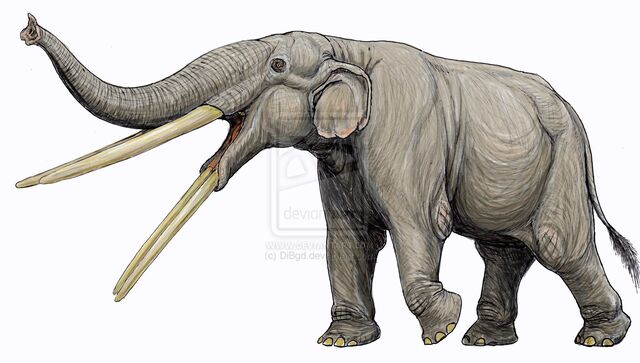
(aka the Osage Orange, Hedge Apple, Horse Apple, Bodarc, etc...).  It makes large, softballsized fruits that plop around but rarely eaten by animals other than gnawed on by a rodent.  During the ice age, the tree was growing from sea to shining sea. However, once the last Gomphotheres were driven into extinction, the tree couldn't disperse its seed and has been fading away ever since, aided into oblivion by humans who used their wood to fashion the same bows to perform the coup de grace of the incredible, Serengeti-like wildlife North America once had. The trees still faithfully make their fruit, but their dance partner is a ghost only they can know. Scientifically, these haunted antelopes and trees are referred to as evolutionary anachronisms.


Stegotetrabelodon

As I feel the lonely, cold wind blow standing beneath a haunted Hedge Apple tree, I strain to listen to the Call of Distant Mammoths. I wonder what my walk in the woods would be like if peeking at me over the tree would be a gigantic Megatherium munching on the fruits.  (I also wonder if I'll go to graduate school and study this lost Serengeti, and end up wearing hipster glasses like the narrator of the following video.)

Here's a great PBS video to sum up the book in a nutshell (get it, nutshell?):


Tuesday, December 31, 2013

For auld lang syne

Fast away this old year passes, and as it comes to a close, the last of "The Old Guard" died.  Margi was our last cat from the 20th century, and we had her euthanized yesterday morning since her kidneys had failed and she was starting to have serious trouble moving and eating. She had a good life as cats go, and lived to the grand ol age of 21. She did complain a lot about moving, but always claimed the bed wherever we went. She now joins the rest of the gang of cats she shared most of her life with: Sunshine, Muffin, George, and Pumpkin.


Good bye, Margi.

Thursday, November 7, 2013

Urge For Going

See the geese in chevron flight flapping and racing on before the snow
They've got the urge for going, they've got the wings to go
They get the urge for going
When the meadow grass is turning brown
Summertime is falling down and winter is closing in
I'll ply the fire with kindling and pull the blankets to my chin
And I'll lock the vagrant winter out and bolt my wandering in
-- J. Mitchell


Pipe Shrine Spiral
It's amazing to realize another year at the Four Corners has passed.  It was a strange ending to the season; I only felt half present on the hectic last day of work.  I looked for the ravens that had greeted me many years ago, but they were elsewhere.  So at the end of the day, I went to the south wall of Pipe Shrine House to see the stone spiral, and then hurried on to watch a cold sunset over Point Lookout.

We had a short break before moving, so I took the chance to return to Silver Mountain.  The last of the aspen leaves were falling, and the overgrown path to the old mine near tree line fit my mood.  From there, it was a steep hike up to the ridge where the frosted summit waited.  Strange to think I will likely never stand on this mountain again.

We took our last weekend to do the Great Circle drive around the mountains.  Scotch Creek, where we began our season, was again covered with a dusting of snow and ice forming along the rocks in the stream.  Since the trails were going to be muddy at altitude, we instead went to a small park south of Ridgway along the shores of the Uncompahgre, where a magnificent eagle statue was frozen in mid flight.

Silver Mountain

We then spent a nice anniversary evening at a bed and breakfast in Ouray called the Secret Garden.  The room was so comfortable, we slept in late and missed our morning hike.  We stopped at Jackson Lake to dig snow out of the grill at the picnic area and roast some hot dogs, as a meek attempt to appease my need for a campout on our last weekend.  At least the ravens in the cold mountains took notice of our activity!
Scotch Creek and the Coming Winter

Then it was packing up the house and driving to visit family in Conifer.  The 125th anniversary of the Geological Society of America was being held in downtown Denver, so I had to peek in for a few days to attend talks on paleoecology, evolution, meteorology, planetary geology, and dirt.  I learned of species that have come and gone, climates that have come and gone, and even National Monuments that have come and gone (have you ever heard of Fossil Cycad National Monument)?
GSA 125th Meeting

Again, before I was ready, it was time to hit the road one last time for the final journey back to Texas... where Jury Duty, Dentists, and broken appliances await my return.
Good night, Sleeping Ute.


Monday, October 7, 2013

United We Stand?

Have you ever wondered what it's like to work hard on a job where you're consistently asked to take on more responsibility and accomplish the same amount of work with less resources, only to be told you're "non-essential" and your career and all that it depends on is placed in limbo?  In case you haven't, I've included a graphic photo to show what it does to morale and productivity. 

Non-essential government worker receives furlough notice

Last Tuesday, I listened to the sound of trees dying as printers across the country delivered approximately 1.6 million pages of furlough notices to 800,000 "non-essentials" and begun the cycle of wasting time, money, and resources; both public and private.   As I drove through the entrance of Mesa Verde National Park, watching our Law Enforcement rangers turn back confused campers, I began thinking about the campground, restaurants, lodge, museum stores and the private workers who are now jobless with all the food lost as waste.  It occurred to me that this scene was playing out across the entire country;  experiments ruined, research and work left unfinished as their season ends, projects delayed or canceled, grants frozen, contracts lost... Perhaps the best example I know of and care about is MAVEN, the latest spacecraft ready for launch to visit Mars.  If it misses the launch window this November, the cost of delaying it for 2 years for the next possible window would cost $50-$100 million. 

All this waste is in the name of politics; essentially shredding mounds of cash for no results.  Now threats of a default loom, sure to spark instant inflation and likely the next recession, causing a much larger budget hole than anything being debated... wait, debate sounds like too rational of a process... anything being rabidly thrashed around in the dysfunctional pit of politicians known as Congress.  An article by MarketWatch sums up my opinion perfectly.

Seventh Falls, Silver Creek


Despite this stink of politics tarnishing the season, I have attempted to use the time given to enjoy a few more unexplored corners of the area.  A bushwhack up a mossy mountain creek rewarded me with 7 waterfalls, some with snow and ice from last week's weather.  My goal was Silver Mountain, but too much time wandering the creek and the sun setting early, I decided to turn back rather than get caught in the dark.


The aspens seem to be having a dull show this year at high altitude, but the oaks and willows of the canyons look stunning.  A few juvenile hummingbirds are still around, but soon they will be gone, and so shall we.  Two more weeks and we drive off to Denver to spend a week there, and then back to Dallas.

Bear Creek Canyon

The garden is done for the year, so the last of the meager harvest is just a few peppers, tiny tomatoes, and 2 small pumpkins.  Tonight, I hope to catch a few more bright fireballs of the Draconid meteor shower in the crystal clear night skies we've had the past few days.

Last of the Summer's Harvest